

This is the final article in January’s series introducing Ecological Aliveness Theory. We’ve explored how your physical environment shapes cognition (Place) and how the structure of your activities trains cognitive habits (Pursuits). Today: Perspective—your relationship to thinking itself.
Your mind wanders. You know this.
You’re in a conversation and suddenly realize you’ve missed the last thirty seconds. You’re trying to fall asleep and the thoughts won’t stop. You sit down to be present with someone you love and your mind is already somewhere else—three days ahead, rehearsing a meeting that hasn’t happened yet.
You try to focus. The mind has other plans.
This isn’t occasional. Research suggests we spend nearly half our waking hours somewhere other than where we are. Lost in thought. Planning, rehashing, simulating, worrying. The mind doing its thing, whether we asked it to or not.
Here’s a question worth sitting with:
If your mind seems to do what it wants half the time—if you can’t always direct it, can’t always quiet it, can’t always be where you are—why do you identify so strongly with it?
We say “I think” as if we’re the one doing it. But often, if you watch closely, it feels more like thinking is happening to you. Thoughts arise. Spiral. Repeat. You didn’t choose to replay that awkward exchange from Tuesday for the fifteenth time. You didn’t decide to spend your shower mentally drafting emails. It just... happened.
And yet: we treat this mind as self. We fuse with it. “I am a strategic thinker.” “I’m an analytical person.” “I’m someone who lives in my head.”
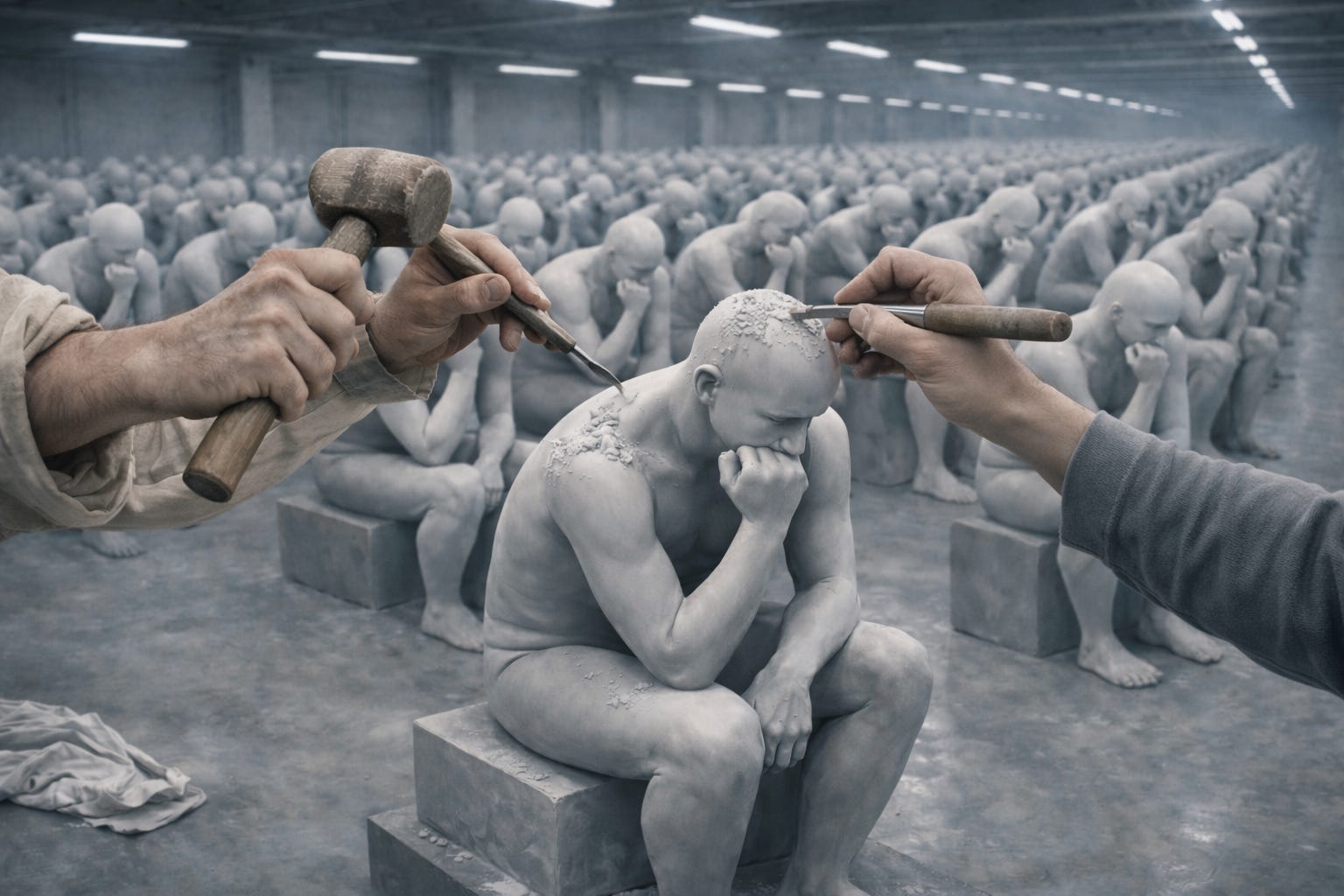
What if that fusion is learned? What if it didn’t have to be this way?
There are cultures that relate to thinking very differently.
The most striking examples come from immediate-return societies—communities that still live close to how humans evolved for most of our 300,000-year history. Anthropologists studying these groups notice something consistent: thinking isn’t welded to identity the way it is for us. It’s held lightly. Picked up when useful. Set down when not.
These aren’t simple people living simple lives. They navigate complex social dynamics, track animals across vast landscapes, make high-stakes decisions with incomplete information. But they do it using thinking as one way of knowing among several.
They also draw on embodied knowing—intelligence that lives in the body, not just the head. Intuition sharpened through years of direct experience. An ability to read people and situations through sensory attunement rather than analysis. A felt sense of what a moment requires before any conscious reasoning kicks in.
Their physical environments and cultural perspectives cultivate this way of being. They don’t train “analytical skills” versus “soft skills”—they develop fluid, contextual intelligence that moves between modes based on what’s needed.

Here’s what’s interesting: these capacities—intuition, embodied cognition, situational awareness, presence, adaptive responsiveness—are exactly what researchers are now identifying as uniquely human capabilities for the age of AI.
The EPOCH framework from MIT’s Sloan School of Management, for example, emphasizes that as machines take over routine analytical tasks, human value will increasingly lie in these harder-to-automate capacities. The skills we’ll need most are the ones these cultures never lost.
We, obviously, don’t experience things this way.
For most of us, thinking isn’t a tool we pick up and set down. It’s the water we swim in. It’s running constantly, and we’re so immersed in it we don’t notice there’s anything else.
How did we get here?
The story is longer than most people realize—about ten thousand years long.
Before agriculture, humans lived in what anthropologists call immediate-return environments. You foraged, you ate. You hunted, you fed your family. Action and outcome were tightly linked. The present moment was where life happened, because that’s where feedback lived.
The Agricultural Revolution changed the temporal structure of human life. Suddenly survival depended on thinking about later. Planting now for harvest months away. Storing grain for next year’s scarcity. Managing land and livestock across seasons. The mind that could simulate the future—that could hold abstract plans and run mental scenarios—became essential for survival.
This was the first step up what I call the Ladder of Abstraction. Cognition shifted from present to future, from concrete to abstract.
The Industrial Revolution took another step. Work moved indoors, onto schedules, away from natural rhythms and embodied craft. The factory didn’t need your intuition or your felt sense of materials. It needed you to perform cognitive tasks reliably, repeatedly. The body became secondary. The analytical mind became primary.
Then came the Digital Revolution. Screens everywhere. Reality increasingly mediated through symbols, text, interfaces. We started spending most of our waking hours not in direct sensory contact with the world, but in abstract representation of it. Email. Documents. Spreadsheets. Feeds.
Each transition trained cognition further into abstraction and away from embodied, present-moment awareness. But something else shifted too—something more subtle.
It wasn’t just our thinking that changed. It was our relationship to thinking.
Somewhere along the way, we stopped using the analytical mind as a tool and started being it. Identity fused with cognition. “I think, therefore I am” stopped being philosophy and became lived experience. The observing awareness that can notice thoughts arising—that can hold thinking lightly and set it down—got buried under the constant stream.
We forgot there was ever an alternative.
This is almost completely overlooked in modern approaches to development and wellbeing.
Consider what we actually teach.
We teach people what to think—content, facts, frameworks. We teach them how to think—critical thinking, strategic thinking, systems thinking, design thinking. We offer productivity systems to organize thinking more efficiently, and meditation apps to quiet it down when it gets too loud.
But we almost never address the deeper question: how do you relate to thinking itself?
Is it a tool you use, or a current you’re swept up in? Can you engage it deliberately and set it down when it’s not needed? When you try to be present—really present—who or what is the thing that keeps pulling you back into analysis and simulation?
These questions aren’t asked. We’re only beginning to recognize the extent of the gap.
The fusion of identity with analytical cognition is so complete, so culturally reinforced, so invisible as the medium we swim in, that most people don’t know there’s anything to examine. They assume the constant thinking is consciousness. They assume the inability to be present is just a personal flaw to be managed. They’ve never been shown that their relationship to thinking is itself a learned pattern—one that differs dramatically across cultures and throughout human history.
The Perspective dimension of Ecological Aliveness Theory addresses exactly this.
Your cognitive flexibility isn’t just shaped by your physical environment (Place) or the structure of your work and activities (Pursuits). It’s shaped by something more fundamental: what you’ve been taught thinking is, how you’ve learned to relate to it, and whether you’ve ever been given permission to hold it differently.
What can you do about this?
Start with noticing.
Not fixing, not changing—just noticing. When your mind wanders without permission. When you try to be present and get pulled away. When you realize you’ve been lost in thought and don’t know for how long.
Notice the gap between who you think is running your mind and who actually seems to be in charge.
This isn’t a failure to correct. It’s information. You’re observing a relationship that was trained into you—by culture, by education, by ten thousand years of history—and you’re beginning to see it as a relationship rather than as simply “how things are.”
From there, you can experiment. Holding thinking more lightly. Recognizing it as one mode of knowing among several. Giving yourself permission to access other modes—embodied awareness, intuition, felt sense—without dismissing them as less rigorous or less real.
The capacities that will matter most in the age of AI aren’t skills to install from scratch. They’re natural human capacities that have been suppressed by a particular relationship to thinking. Change the relationship, and they can re-emerge.
This month’s Alive Paper—Ecological Aliveness Theory: Developing the Uniquely Human Capabilities for the Age of AI—explores all three dimensions in depth and offers frameworks for individuals and organizations ready to restore cognitive flexibility systematically.
You can access it here.
Who taught you how to think?
You probably had teachers, parents, mentors who shaped your analytical capabilities. You learned what to think about. You learned methods for thinking well.
But who taught you how to relate to thinking? How to use it without being used by it? How to hold it lightly, engage it deliberately, and set it down when presence is what’s needed?
Probably no one. That education doesn’t exist in most of the modern world.
It might be the most important education there is.
—James
Working with The Alive Institute: I help individuals and organizations restore cognitive flexibility through workshops, experiential programs, and assessments grounded in peer-reviewed research.
Learn more at TheAlive.Institute
Email James@TheAlive.Institute for inquiries.
Note on AI collaboration: The Alive Letter explores how humans can stay fully human while learning to work with modern technology. In that same spirit, I collaborate with AI in the creation of these articles. As an industrial/organizational psychologist who studies human-AI collaboration, I carefully guide, refine, and evaluate AI outputs. At its best, this partnership helps me more clearly and authentically communicate my own thoughts and perspectives than I am able to alone.