

If you’ve listened to The Alive Conversations, you’ve heard the intro.
It starts with traffic. Engines, horns, the friction of the commute. Then the office—keyboard clicks, fluorescent hum, the ambient noise of productivity. Then footsteps. Rustling leaves. Birdsong. Wind. Water.
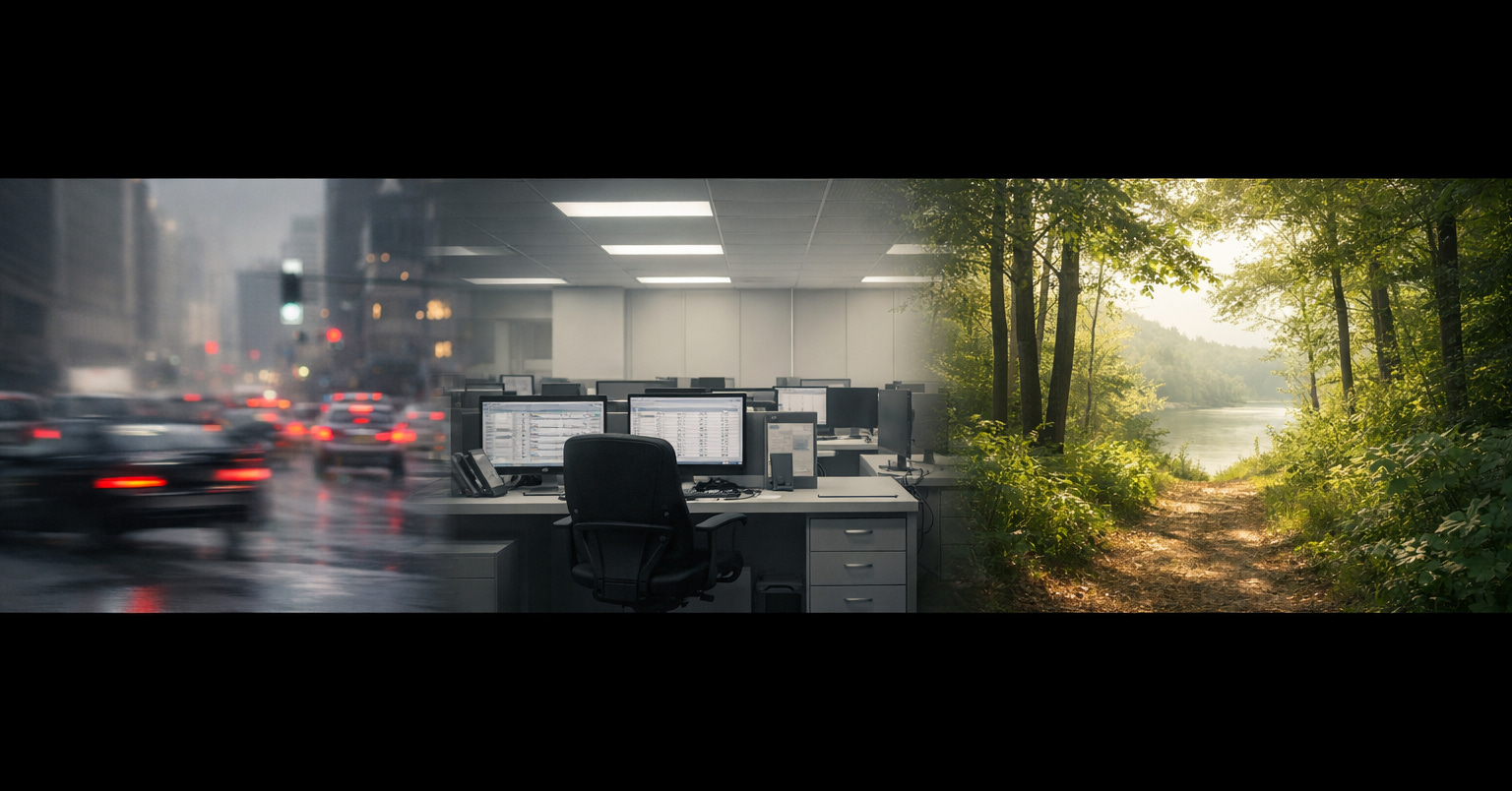
Twenty seconds. No words. Just a soundscape that traces the journey most of us take in reverse—if we take it at all.
I designed it that way because the sequence does something. You can feel your nervous system respond as the sounds shift. The shoulders drop. The breath slows. Something begins to settle.
I’m a researcher by training. My instinct is to build the case—cite the studies, explain the mechanisms, walk through the evidence. There’s a 45-study scoping review on nature and creativity I could summarize for you (I tried to in yesterday’s podcast). There’s Attention Restoration Theory. Stress Reduction Theory. The Biophilia Hypothesis.
But today I want to resist that instinct. Forest, not trees. Because there’s a core insight here that risks getting lost in the details, and it’s too important to bury.
Here it is:
We’ve been framing the benefits that nature has on cognition backwards.
The research literature says: spending time in nature increases creativity, reduces stress, improves cognition.
That framing makes nature sound like a supplement. A bonus. Something to add to an already-complete life if you have the time and inclination.
But consider the context.
Homo sapiens have been around for 300,000 years. For 97% of that history, every human lived immersed in natural environments. The office, the commute, the 90% of time spent indoors—that’s the last blink of an eye, evolutionarily speaking.
So when studies show that “nature improves cognition,” what they’re actually showing is that removing nature degrades cognition—and we’ve just normalized the degraded state.
We’re not adding a bonus when we step outside. We’re removing a deficit.
The irony is sharp: we removed ourselves from the environment our minds evolved in, and now we’re running studies to figure out why being in that environment helps.
In yesterday’s podcast episode, I explored this reframe in depth. The General Unsafety Theory of Stress proposes something similar: stress isn’t caused by the presence of threat, but by the absence of safety signals. The nervous system doesn’t need something bad to happen. It just needs the signals that say “you’re okay” to go missing.
Nature is one of those signals. Not the only one, but a foundational one. Take it away, and the system doesn’t crash—it just runs slightly degraded, all the time. Stress a little higher. Attention a little more fragmented. Cognitive flexibility a little more constrained.
Aliveness a little more out of reach.
This is why Place is the first dimension in the Aliveness Model.
Not because nature is a nice addition to modern life. But because your physical environment is continuously shaping your cognitive state—whether you notice it or not. The places you spend your time are either supporting the mental flexibility that lets you feel fully alive, or quietly eroding it.
Unfortunately, the environments of modern life actively, if unknowingly, train your mind for cognitive rigidity.
Most of us have arranged our lives in ways that systematically deprive our nervous systems of what they expect. Not intentionally. Just by following the logic of convenience, productivity, and how things are done.
The result isn’t dramatic. It’s subtle. A slow flattening. Days that blur. The sense of watching your life rather than inhabiting it.

The good news: this isn’t a problem you need to solve. It’s a relationship you can restore.
Start with awareness. Just noticing—really noticing—how your mind changes in different environments is itself valuable. Pay attention to what happens when you step outside for lunch versus eating at your desk. Notice the difference between a video call in a windowless room and one where you can see sky. Track your own cognition like a curious scientist. Where do you think more clearly? Where does the mental grip loosen? The answers might surprise you.
Then, experiment. Search for “biophilic design” and consider what elements you might bring into your workspace or home—natural light, plants, wood textures, even images of natural scenes. These aren’t substitutes for actual time outdoors, but they shift the baseline. Get outside more, even briefly. Listen to natural soundscapes while you work. Each of these interventions has research support, but more importantly, you can test them yourself and feel the difference.
This is why Place is the first dimension of the Aliveness Model. Not because it’s the most important—all three dimensions matter—but because it’s the foundation. Your environment shapes what’s cognitively available to you. Change the environment, and you change what’s possible.
We don’t need a cabin in the woods. But we do need to stop treating nature as a luxury and start treating it as cognitive infrastructure.
So, it’s not that “nature is good for our minds” - it’s not. It’s that “removing nature is bad for our minds”. And that reframe matters.
Next week: Pursuits.
—James
Working with The Alive Institute: I help individuals and organizations restore cognitive flexibility through workshops, training programs, and assessments grounded in peer-reviewed research.
Learn more at TheAlive.Institute
Email James@TheAlive.Institute for inquiries.
Note on AI collaboration: The Alive Letter explores how humans can stay fully human while learning to work with modern technology. In that same spirit, I collaborate with AI in the creation of these articles. As an industrial/organizational psychologist who studies human-AI collaboration, I carefully guide, refine, and evaluate AI outputs. At its best, this partnership helps me more clearly and authentically communicate my own thoughts and perspectives than I am able to alone.