

This is the second article in January’s series introducing Ecological Aliveness Theory. If the capabilities that matter most in the age of AI—creativity, adaptability, presence, connection—all depend on cognitive flexibility, then we need to understand what suppresses it and what restores it. Last week: Place. This week: Pursuits.
You know this feeling.
You’re trying to be present—with your partner, your kids, your friend—and your mind keeps leaving. To the email you haven’t sent, to the meeting next week, to the project you’re worried won’t work.
You tell yourself to focus. The thoughts keep coming.
We’ve been told this is normal. The “monkey mind”, as meditation teachers sometimes call it. It’s just the default mode of human cognition. Something we should strive to overcome.
But what if your mind isn’t broken?
What if it’s doing exactly what it evolved to do—just in an environment it was never designed for?
The Mind That Tracks
Your mind evolved to track unfinished business. Psychologist Bluma Zeigarnik discovered this a century ago: incomplete tasks create cognitive tension that persists until resolution. The mind holds them active, keeps returning, won’t let go.
This is useful. If you’re tracking prey, you shouldn’t forget about it. If you started building shelter, your mind should nudge you to finish before dark.
The system works when tasks actually end. Chase, catch, done. Build, complete, done. Loop closes. Mind releases. Resources free up.
Now consider modern life.
When did you last feel genuinely done? Not “done for now” or “done enough” or “done pending more information.” Actually complete. Loop closed. Mind released.
We carry financial goals with no clear endpoint. Health goals that shift as we age. Parenting goals we won’t know the outcome of for decades. Home maintenance that never finishes. An endless stream of decisions about things our ancestors never had to decide—what to eat, what to watch, which of forty-seven options to choose.
The loops stay open. The mind keeps tracking.
For knowledge workers, this intensifies. Work goals stretch across quarters and years. Completion criteria blur—when exactly is a strategy “done”? Feedback arrives late or never, often disconnected from the effort that produced it. You carry dozens of professional open loops on top of all the personal ones, each pulling at attention, each demanding cognitive resources that never get freed.
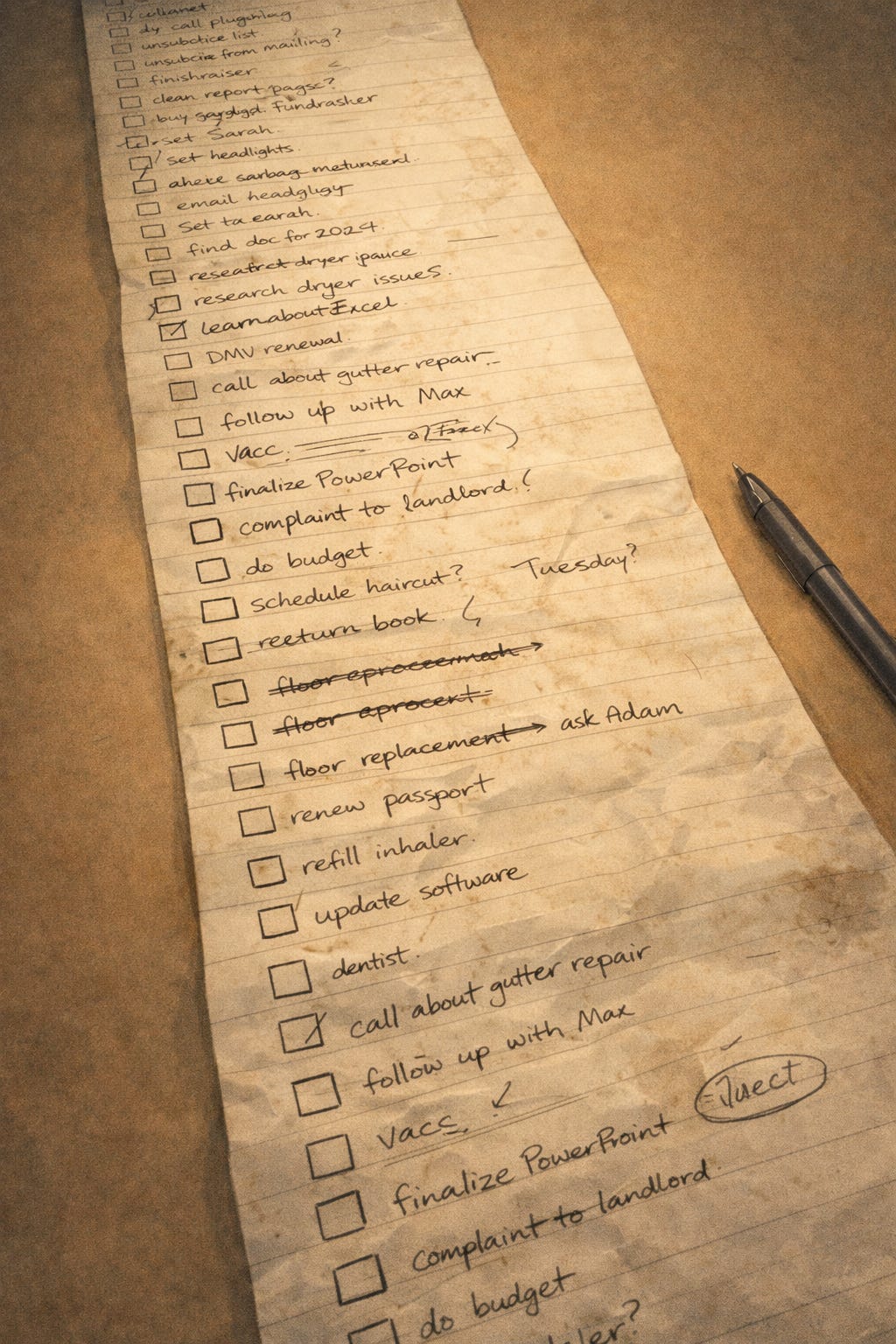
Your mind does what it evolved to do. It keeps tracking. It keeps returning. It keeps trying to close loops that won’t close.
And we feel it. And we think its normal.
The Mind That Compensates
When the environment doesn’t provide feedback, the mind simulates it.
Researcher and professor Leonard Martin calls this I-D Compensation. We evolved in immediate-return environments where effort produced visible results within hours. Delayed-return environments provide no such clarity. So the mind compensates—simulating outcomes, rehearsing scenarios, speculating endlessly about what might happen.
That mental chatter isn’t noise. It’s your cognitive system compensating for the feedback signals your environment cannot provide.
You can see this in the research. A 2024 study tracked procrastination and mind-wandering over four months. Procrastination—leaving tasks open, unresolved—predicted future mind-wandering. But mind-wandering didn't predict procrastination. The structure creates the symptom, not the reverse. Deny the mind closure, and it starts simulating.
But there's a clue. Simply making a concrete plan for when and how you'll complete a task quiets some of the simulation—even though the task remains undone. Not full closure, but enough signal that the loop will eventually close.
It’s not asking for much. Just clarity. Just some signal that the loop will eventually close.
The Hunt Reversed
Many people experience it strongly on Sunday evenings.
The weekend is technically still here. But their mind has already left, scanning the week ahead, sorting priorities, rehearsing conversations that haven’t happened yet. Their partner is talking. They are nodding along, but they’re not really there.
This is what it feels like when the chase reverses. You started out pursuing goals. Now they pursue you. They occupy your evenings, your weekends, your time with people you love.

We’ve become so habituated to this state that we mistake it for baseline—the default condition of the human mind. But it’s not. It’s compensation. Adaptation to an environment the mind was never designed for.
And it costs us something essential.
Not just productivity. The very capacity to be here. To connect with another person without part of your mind tracking the open loops. To access the embodied intuition that only emerges when the analytical mind quiets. To feel fully alive rather than perpetually elsewhere.
Cognitive flexibility—the ability to shift between abstract thinking and concrete presence—is emerging as a core human capability. One of the things that make us uniquely human, something that AI can’t replicate. The thing that makes creativity and genuine human to human connection possible.
Modern environments, especially modern work environments, suppress it systematically.
What the Mind Actually Needs
The good news is structural.
Your mind is already being shaped by your environment—the delayed-return structure of modern work is already training your cognition. This is the water you swim in.
But that means the lever is accessible. Give your mind what it needs—clarity, feedback, closure—and the compensatory simulation quiets. Not through willpower. Through slight environmental adjustments.
I’ve started practicing what I call “one and done” thinking. When my mind returns to the same topic repeatedly—the same worry, the same decision, the same unresolved thread—I stop. I either address it fully then and there, taking the time needed to do so, or I plan and schedule (actually write it down, schedule time, as if it was an important appointment) time to do it later. Make a decision or make a plan and write it down. Then the mind can say to itself “we’ve handled this. No need to keep tracking.”
This kind of “cognitive offloading” is simple but it really works. Write things down. Make concrete plans. Begin to harness the power of your mind’s ability to simulate so you can use it when you want to, on your terms.
Also, create closure where you can. Not just to-do lists—done lists. Actively marking completion. Your mind is seeking that signal. Give it.
And find pursuits that actually end. There’s a reason hobbies tend toward immediate feedback: golf, cooking, woodworking, puzzles, even video games. Effort, feedback, completion, release. This isn’t escapism. It’s restoration. Your mind briefly gets what it was designed for.
The Pursuits Dimension
This is what Ecological Aliveness Theory calls the Pursuits dimension: the structure of what we do and whether it gives the mind what it needs.
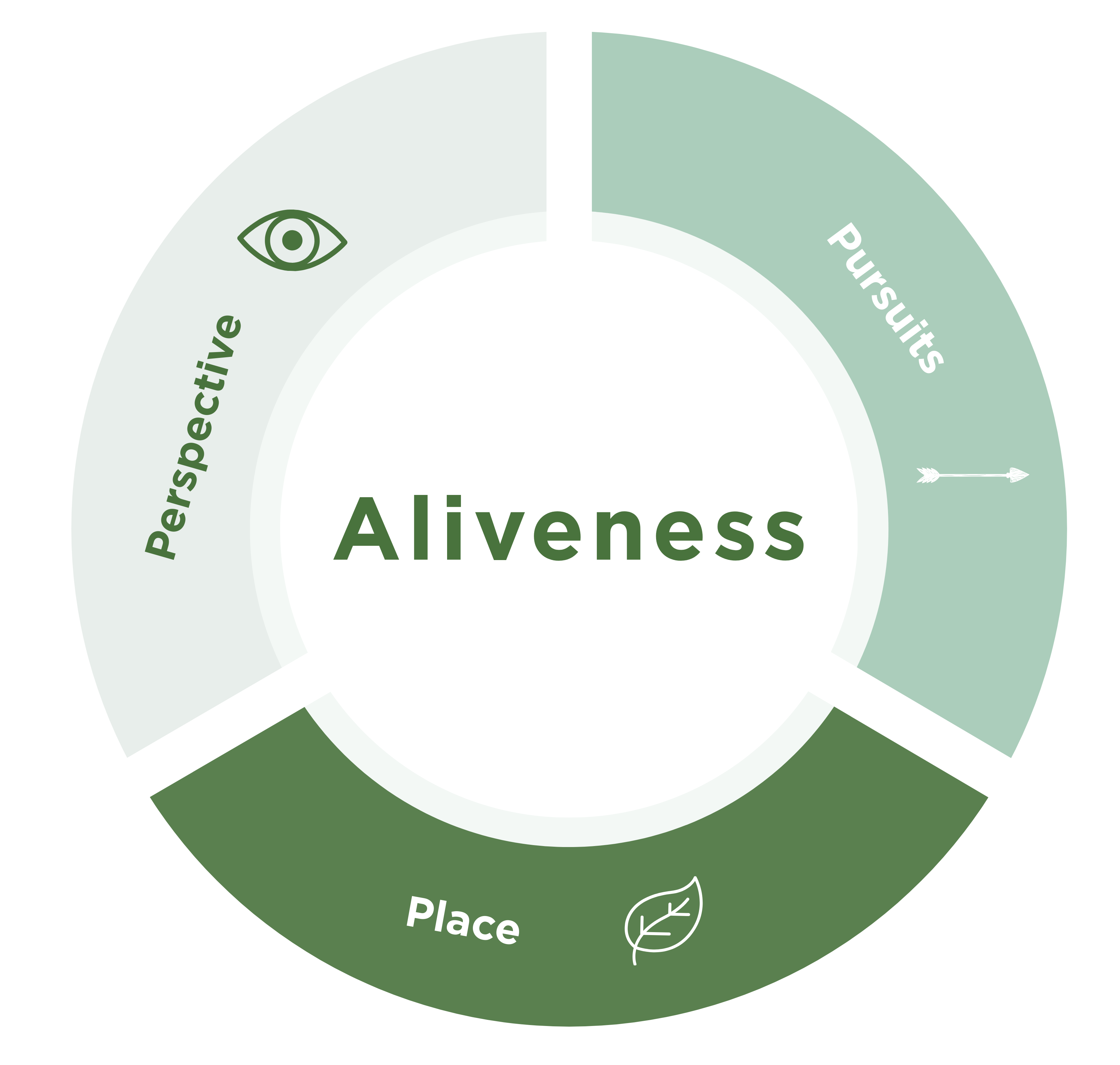
Last week we discussed the Place dimension. Place shapes our cognition through the physical environment. Embed nature where you can, become attuned to how different environments shift your cognitive states.
Pursuits shape us through task feedback and closure—whether our activities resolve or remain perpetually open.
The uniquely human capabilities that matter most now—creativity, adaptability, presence, connection—all require cognitive flexibility. And cognitive flexibility requires a mind that isn’t constantly compensating for missing feedback, endlessly simulating closure it never receives.
We don’t have to live in the state we’ve mistaken for normal.
Our goals don’t have to constantly chase us.
Small structural changes—clarity, feedback, closure—restore access to what was never lost. Just buried. Under all the open loops we’ve been carrying.
If this resonated with you, send me an email to learn more: james@thealive.institute
Next week we learn about how cultural narratives and norms, what we call cultural Perspective, shapes our cognition. And how we can leverage it.
-James
Working with The Alive Institute: I help individuals and organizations restore cognitive flexibility through workshops, training programs, and assessments grounded in peer-reviewed research.
Learn more at TheAlive.Institute
Email James@TheAlive.Institute for inquiries.
Note on AI collaboration: The Alive Letter explores how humans can stay fully human while learning to work with modern technology. In that same spirit, I collaborate with AI in the creation of these articles. As an industrial/organizational psychologist who studies human-AI collaboration, I carefully guide, refine, and evaluate AI outputs. At its best, this partnership helps me more clearly and authentically communicate my own thoughts and perspectives than I am able to alone.