


Keeping this one short and to the point.
For the past month, we’ve been climbing a ladder most people never see.
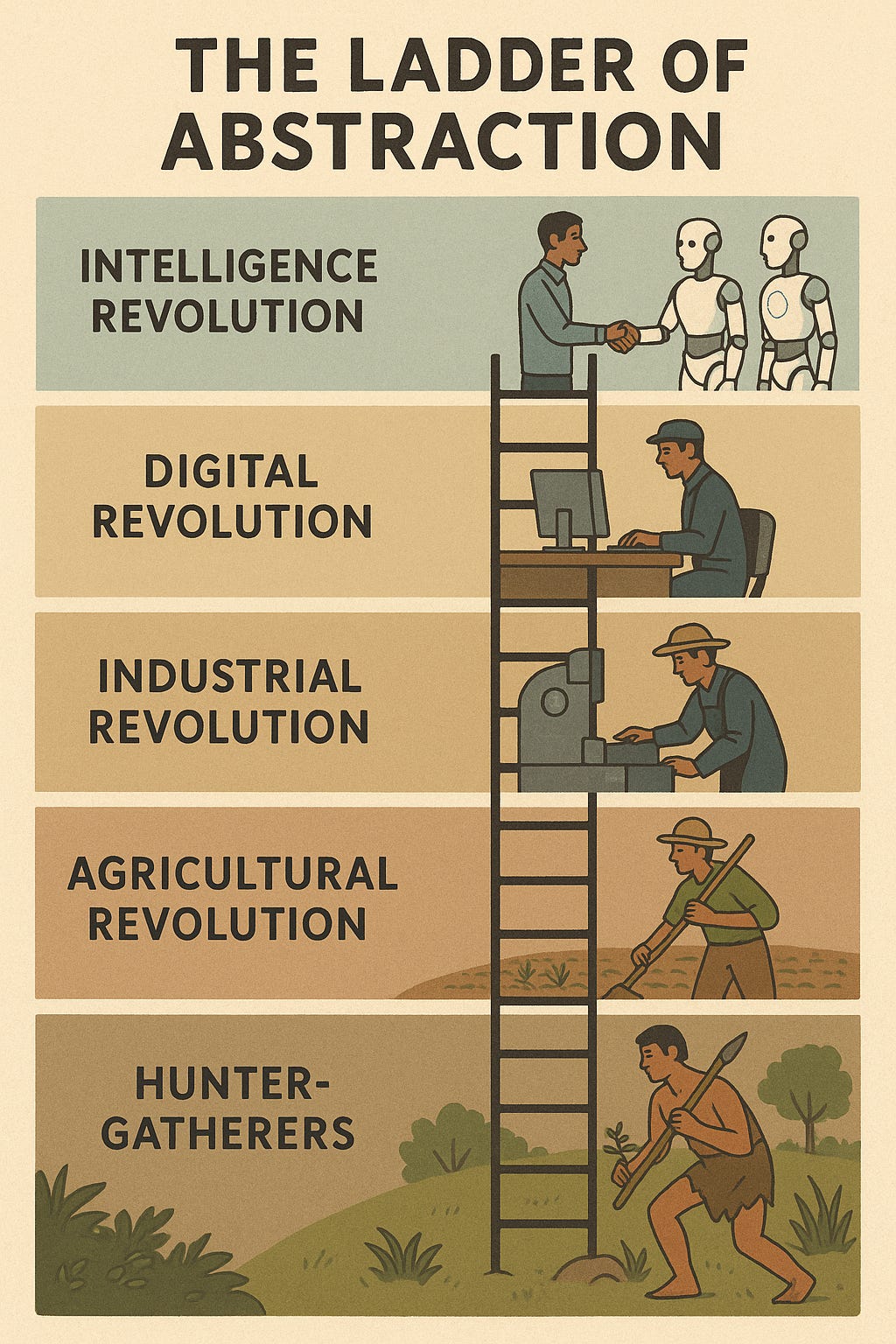
Agriculture pulled our minds into the future.
Industrialization disconnected our bodies from the work we did.
Digital life moved reality behind screens.
Each rung pushed us further into abstraction.
Each made presence harder, not easier.
Each widened the gap between life as experienced and life as imagined.
That’s the point of this series: to show that disconnection isn’t a personal flaw, but the predictable result of 10,000 years of rising abstraction.
And here’s what’s at stake:
We are now stepping onto a rung that changes the nature of thinking itself.
Until now, abstraction was something we did.
We imagined futures.
We ran mental models.
We processed symbols.
We navigated delayed-return worlds by turning the present into simulation.
But now something new is happening.
We’re building systems that can perform the very cognitive work previous revolutions demanded from us.
Not just storing information — thinking with it.
Not just representing reality — generating new versions of it.
Not just responding to instructions — interpreting them, extending them, transforming them.
This is the moment when abstraction begins to externalize itself.
I read about this stuff everyday, and I don’t even comprehend that last sentence.
Think about the pattern:
Rung 1 — Agriculture
We learned to live in the future.
Our nervous system began carrying the weight of uncertainty — months of not knowing.
Rung 2 — Industrialization
Machines took over the physical work.
Our bodies became irrelevant to the thing we were making.
Our environment stopped giving us real feedback.
Rung 3 — Digital
Screens replaced direct experience.
Information detached from matter.
Social life became symbolic.
Presence became almost impossible.
Each rung didn’t just add a new burden.
Each intensified the one before it.
And now:
Rung 4 — The Intelligence Revolution
We are outsourcing the last thing that kept us tethered to ourselves:
our own thinking.
When a system can generate the memo, summarize the research, outline the strategy, draft the email, or even imagine possibilities you haven’t thought of — you’re no longer just using tools.
You’re orchestrating them.
You’re prompting systems that are themselves abstractions.
Layers on layers.
Models inside models.
A meta-meta-level of cognition:
not “doing the thinking”
but “thinking about what the thinking should be.”
And that’s if you are working with just one AI and not a series of AI agents working together.
This is not the future.
This is right now. AI just wrote that.
So what happens on this rung?
We don’t know yet. No one knows.
But here’s the trajectory we can see:
If agriculture pulled us out of the present,
If machines pulled us out of our bodies,
If screens pulled us out of reality,
Then AI risks pulling us out of ourselves.
Out of our own cognitive agency.
Out of the direct feel of reasoning, wrestling, creating, knowing.
None of this is inevitable.
None of it is catastrophic.
But it is a shift we need to see.
Because once you see the ladder,
you understand the real choice in front of us:
Not whether AI will change how we think — it already has.
But whether we will remain grounded enough, embodied enough, present enough
to not lose the very thing all this abstraction was meant to serve:
Our humanness. Our felt sense of being alive in the world.
What Comes Next
This month has been about climbing the ladder — seeing how each revolution pushed us further into abstraction, further out of direct contact with reality, further away from the cognitive environment our brains evolved for.
Next month, we reverse direction.
December’s series: Life on the Ground.
We’re going to look directly at:
• what concrete cognition actually is
—the sensory-rich, feedback-driven mode of thinking that used to be our default
• what we’ve lost
—as abstraction became the air we breathe
• why concrete cognition is emerging as the true foundation of mental health
—not just calm, not just wellness, but the neurological baseline humans require to feel safe, connected, and alive
• and how we can reclaim it
—not by rejecting abstraction,
but by learning to move intentionally up and down the ladder
Not stuck in our heads.
Not trapped at the top.
But able to shift modes —
from conceptual to concrete,
from future to present,
from simulation back to sensation.
This next chapter is about rebuilding the capacity the modern world quietly eroded:
the ability to come back down to earth.
To inhabit your body again.
To feel the world directly.
To live — even briefly — on the ground.
Have a great Thanksgiving. Enjoy the taste of food and the warmth of authentic social connections. Even with that annoying family member. It’s all part of the experience.
Excellent analysis! Thank you for making these complex connections so clear. Your insight on the externalization of thinking and systemic disconnection is realy important for understanding our present.
I’ve been looking forward to this post. My hope is that the externalization of abstract actually forces us step down the ladder. Yes we must be strategic thinkers, but beyond that, why not allow ourselves to be fully back in the body and present moment? AI has made me question basic assumptions — do we even need to know how to read or can we move back to an oral/verbal world, which was the basis of the human experience for the vast, vast majority of our history. Writing was invented by accountants. Perhaps the revolution against an “accounting world” has merits? I for one am so ready to externalize my thinking, which has often served to get me in trouble…