


There’s something they never taught you in school. Something that explains why so many of us feel disconnected despite unprecedented abundance, why we’re exhausted from lives that should be easier than ever.
Once you see it, you can’t unsee it.
We’re living almost entirely in abstraction, and it’s killing our capacity to feel alive.
Who I Am and Why This Matters
I’m James Meaden, an industrial/organizational psychologist who works at the intersection of AI and human cognition. My day job involves designing assessments that help companies figure out how ready their people are to work effectively alongside artificial intelligence—which cognitive skills will matter, which roles will transform, how to develop human capabilities that complement rather than compete with machines.
I’ve also published research in peer-reviewed psychology journals on how our environments fundamentally shape our cognitive patterns—not just what we think about, but how we process reality itself.
I created The Alive Institute because I believe we’re at a critical inflection point. What I’ve discovered in my research has convinced me we’re optimizing for the wrong things. And if we’re not careful, we’re about to make it much worse.
What Is Abstraction?
Let me start with a definition, because most people have never thought explicitly about this.
Abstraction is living in your head instead of in direct experience.
It’s thinking about things rather than experiencing them. Planning future scenarios rather than being present to what’s actually happening. Analyzing your feelings rather than feeling them. Processing concepts rather than processing sensory information.
Here’s what I mean: You’re walking outside right now. You could be feeling the temperature on your skin, hearing birds, noticing the play of light through leaves, sensing your footsteps on the ground. That’s direct experience—concrete cognition.
Or you could be thinking about your next meeting, replaying yesterday’s conversation, planning what you’ll say during that presentation, worrying about whether you’re being productive enough. That’s abstraction—you’re physically outside, but mentally you’re somewhere else entirely.
Both are necessary. Both are deeply human. Abstract thinking is what lets us plan, create, solve complex problems, and build civilization. It’s not the enemy.
But the balance has shifted so dramatically that most of us spend the overwhelming majority of our waking hours in abstract cognition. We’ve become almost entirely disconnected from direct experience. We’ve become abstraction machines.
And we don’t even realize it.
How We Got Here
This didn’t happen overnight. It’s been building for millennia.
For 95% of human history, we lived in what anthropologists call immediate-return environments. Hunt today, eat today. Gather berries, consume them. Make a tool, use it immediately. The feedback loop was tight. Your effort connected directly to outcomes you could see, touch, and experience in real time.
In these environments, direct sensory awareness wasn’t a nice-to-have—it was survival. You needed to notice the subtle shift in wind direction. The track that wasn’t there yesterday. The change in a companion’s expression. The sound that didn’t belong. Present-moment attention was adaptive.
Then came agriculture, about 10,000 years ago. Plant seeds today, harvest in months. Store grain for winter you can’t yet see. Plan for seasons that exist only in your mind. This was the first major abstraction shift. You had to live in your head, modeling future scenarios, delaying gratification. The gap between effort and outcome stretched from hours to months.
And we’ve been accelerating ever since.
Writing externalized thought—knowledge could now exist separate from direct experience, stored in symbols. Industrialization separated work from outcome—a factory worker assembles one component and never sees the finished product. The digital age mediated everything through screens—you tap glass and things happen in server farms thousands of miles away.
Each revolution brought enormous benefits. I’m not romanticizing hunting and gathering. But each technological revolution also required us to spend more time in abstraction and less time in direct, concrete, sensory experience.
And now we have AI. And AI is about to accelerate this beyond anything we’ve seen before.
What We Lose
Think about the last time you felt completely here. Not thinking about yesterday or tomorrow. Not performing or analyzing or planning. Just... here.
Maybe it was standing in the ocean, waves hitting your legs. The first bite of something delicious. Your hands in soil. The moment after a hard workout when everything quiets. Holding a newborn. Eye contact with someone you love, no words needed.
That feeling—that’s what I’m talking about. The closest word I can think of is feeling “alive”. Not alive as in “not dead.” Alive as in that felt sense of being fully present. Of experiencing reality directly rather than through the filter of constant mental commentary.
When you spend the majority of your time in abstract cognition—in your head, thinking about the past or future, analyzing and planning and worrying—you lose access to that state. You lose sensory presence. The felt sense of your body. Awareness of your immediate surroundings. Real connection to the people physically near you.
This isn’t poetic language. This is describing a fundamentally different mode of cognitive processing. When you’re in concrete cognition—processing direct sensory information in the present moment—different neural networks activate. You feel different. Not necessarily better or worse than abstraction, just different. More grounded. More connected. More here.
And most of us spend very little time there anymore.
The Framework That Explains Everything
Here’s why this is happening.
Immediate-return environments are characterized by short gaps between effort and outcome. You act, you get rapid feedback. The environment itself tells you whether you’re doing well or poorly, and it tells you quickly. For 95% of human history, this was the human experience.
Delayed-return environments are characterized by long gaps between effort and reward. Plant in spring, harvest in fall. Work for two weeks, get a paycheck. Invest in a 401k, reap benefits in 40 years. These environments require different cognitive patterns—abstract thinking, future planning, the ability to persist toward goals you can’t yet see or touch.
Our brains evolved for immediate-return. We now live in the most extreme delayed-return environment in human history.
This is the mismatch.
Your anxiety? It makes sense when you realize your brain is constantly trying to model future scenarios because the feedback loops in your life are so long that you never know for sure if you’re actually doing okay.
The constant mental chatter? It’s your mind trying to fill in the massive gaps between effort and outcome, trying to predict and plan and control things that won’t resolve for months or years.
Your sense of disconnection? It makes sense when you realize you’re processing reality almost entirely through abstractions rather than direct experience.
This isn’t personal failure. It’s a mind adapting to a world it was never designed for, its what scientists call an evolutionary mismatch.
Look at Where Wellness Is Going
Once you understand this, you start seeing evidence everywhere that we’re unconsciously trying to solve it.
Look at the evolution of mental health and wellness approaches over the past few decades.
Traditional talk therapy: You sit in a room and talk about your feelings. You analyze about your experiences. You think about your patterns. You’re trying to think your way to feeling better. For many people, it helps. But you’re still entirely in your head.
Now look at what’s emerging in the past 10-15 years:
Mindfulness practices—explicit training to return to present-moment sensory awareness. Acceptance and Commitment Therapy (ACT)—less analyzing feelings, more direct contact with present experience and valued action. Somatic therapies—body-based approaches, getting out of the head and into felt sensation. EMDR—using bilateral stimulation to process trauma through the body, not just through talking about it.
Nature-based therapy. Wilderness therapy. Forest bathing. Equine-assisted therapy—where you work with horses who respond to your actual present state, not your story about your state. Breathwork. Cold exposure. Movement practices. Embodied leadership training.
Every single one of these emerging approaches is trying to move people from abstract cognition back to concrete, embodied, connected experience.
We’re collectively discovering that we can’t think our way out of problems created by too much thinking.
And here’s what’s fascinating: we’re treating this as individual therapy. As something broken people need to fix about themselves. But what if it’s not individual pathology? What if we’ve designed environments that systematically suppress concrete cognition, and then we’re selling people practices to try to get it back?
Individual practices matter. I’m not dismissing them. But they’re not sufficient. We need to start asking: How do we design environments—workplaces, cities, schools, daily routines—that naturally support both abstract capability and concrete presence?
Because right now, we’re designing almost entirely for abstraction. And we’re about to accelerate dramatically.
The AI Acceleration
Here’s what’s coming.
Within the next few years, AI will be better than humans at most routine cognitive tasks. The skills that will remain valuable for humans are precisely the most abstract: complex problem-solving, strategic thinking, creative synthesis across domains, navigating ambiguity, making sense of contexts that can’t be fully specified.
Every “AI readiness” framework I’ve seen emphasizes these higher-order thinking skills. And they’re right—these are the capabilities humans will need to remain valuable in an AI-augmented economy.
But here’s what almost no one is talking about: All of these skills require sustained abstract cognition. More time in your head. More time modeling futures, less time experiencing the present. More conceptual processing, less sensory awareness.
If we’re not careful, we’re going to optimize entirely for abstract capabilities at the expense of aliveness. We’ll become more productive, more adept at abstract processing, more economically valuable—and less human.
But it doesn’t have to go that way.
We’re at a choice point. We can sleepwalk into a future of increasing abstraction and disconnection, or we can consciously design for both abstract capability and concrete connection. Both material progress and psychological flourishing. Both intelligence and aliveness.
This isn’t anti-technology. I’ve built AI systems. I’m not a Luddite, and I’m not suggesting we all return to gathering berries full-time (though I did go apple picking last weekend).
I’m saying we need to become conscious architects of our cognitive environments. We need to understand that the way we design work, cities, schools, and daily routines fundamentally shapes how we experience being human. And right now, we’re designing almost entirely for abstraction without understanding the cost.
What This Work Actually Is
Let me be clear about something: this isn’t about being against abstraction.
Abstract thinking is extraordinary. It’s what lets us solve complex problems, build systems that serve billions of people, create art that didn’t exist before, understand concepts that can’t be touched.
The problem isn’t abstraction itself. The problem is the imbalance.
When you spend the majority of your waking hours in abstract cognition with almost no time in direct, sensory, embodied experience—that’s when you lose connection to what makes you feel alive. That’s when anxiety spikes, when disconnection becomes chronic, when you look around at your materially abundant life and feel... empty.
So this conversation isn’t about choosing one over the other. It’s about conscious integration.
In this series, we’ll explore both sides:
How to develop and harness abstract cognitive capabilities (and stay relevant in a world of increasingly intelligent technology)
AND how to reclaim your natural capacity for grounded, connected, embodied presence
Both matter. Both are human. And learning to harness both … I think that’s the ideal, at least as far as I can see.
Why “ALIVE”
This is why I created The Alive Institute. And why I moved away from my earlier work under the name “Mindful Origins.”
“Mindfulness” has become something you practice. Something you do sitting on a cushion with your eyes closed for 20 minutes before work. A stress-reduction technique. A way to relax. It’s been reduced to a personal wellness practice—something broken or stressed people do to feel better.
But ALIVE—that’s what people actually say when they experience what I’m trying to point toward. When they’re fully present. When abstract thinking quiets and direct experience takes over.
“I felt so alive.”
Not “I felt mindful.” Alive.
Wind on your face. Hands in soil. Real eye contact with another person. Your body moving through space. The feeling of being fully here.
And my research shows that this isn’t just about individual practice. Your environment matters. The structure of your work matters. Whether you get immediate feedback or delayed feedback matters. Whether you learn through experience or through a Coursera video matters. Whether you spend time in nature matters.
And here’s the thing: these are all designable. They’re not personality traits you’re born with. They’re features of the environments we build. Which means we can build differently.
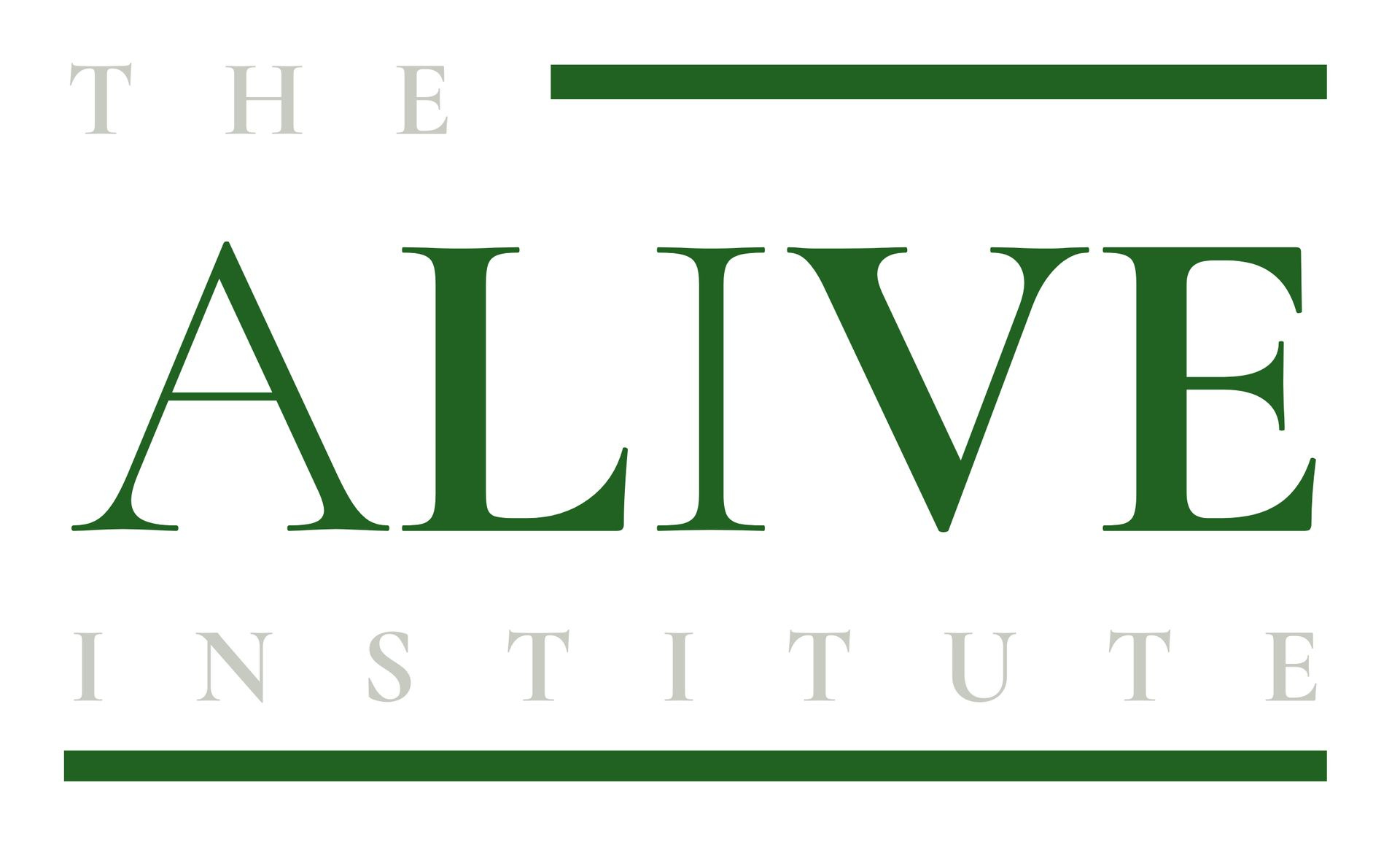
And the name itself—The ALIVE Institute—the story is in the logo. The ‘A’ and ‘I’ aren’t bolded. They’re there, embedded in the name, just like technology is embedded in our modern lives. But they take a backseat. What’s emphasized is our aliveness—what it means to be truly human. That’s the visual representation of what we’re after: technology integrated, but not dominant. Humanity, presence, aliveness—that’s what should stand out.
Because that’s what we need. People who can do the abstract cognitive work that the AI age will demand, while also maintaining connection to concrete, embodied, sensory experience. People who can thrive alongside AI without losing their humanity.
That’s the goal.
What’s Coming
In the weeks and months ahead, I’ll be exploring:
The skills we’re losing — Why children are forgetting how to learn through experience. What happens when you never get immediate feedback. The cognitive capabilities that are disappearing from modern workplaces (and why your company should care).
How to design differently — Not just individual practices, but environmental design. How to structure work for both productivity and presence. What organizations can do beyond meditation apps.
The research that’s emerging — From cognitive psychology, anthropology, environmental psychology. What Indigenous communities can teach us about cognitive patterns we’ve lost. What the science actually says about how environments shape minds.
Living the integration — My own experiments trying to hold both worlds. What’s working, what isn’t, what I’m learning.
This is just the beginning of the conversation.
The One Thing
So here it is—the one thing I wish everyone understood:
The way we’ve designed modern life systematically suppresses our natural capacity for present-moment awareness and direct experience. Each technological revolution has required more abstraction, and AI is about to accelerate this dramatically. We’re not broken for feeling disconnected—we’re responding normally to environments that are fundamentally mismatched with how our minds work.
Once you see this, you can’t unsee it.
You start noticing how much time you spend in your head. You start seeing the abstraction in everything—in how offices are designed, in how meetings are structured, in how you interact with people through a constant filter of mental commentary and evaluation.
And that’s when it gets interesting.
Because once you see the problem, you can start designing differently. You can start asking: How do I structure my day to include immediate feedback loops? How do I learn through experience, not just PowerPoint slides? How do I ensure I’m spending real time in nature, not looking at it through screens? How do I connect with people in ways that aren’t entirely mediated by abstractions?
These aren’t just lifestyle questions. They’re environmental design questions.
And the answers matter more than we realize.
Welcome to the conversation.
James
P.S. — If this resonated, forward it to someone who needs to read it. This conversation is just getting started.
Thanks for writing this, it clarifies a lot. More on cognitive patterns?