

This is the third article in December's series, "Life on the Ground." In November, we climbed the Ladder of Abstraction—tracing how each technological revolution moved humans further from direct experience. This month, we're exploring what's still there at the bottom. Last week, we examined immediate feedback. This week: how knowledge moved through a community before we invented "education."
Two things before we begin:
1. Sorry for the delay, I try my best to release these every Wednesday, but this past week was especially busy as I was finishing up work and packing for a short vacation to San Juan. Here is the view from the room as I’m working on this article :)

As mentioned at the end of every article, I use AI to “help” write these articles. However, some articles—including this one—are fully written by AI with heavy editorial guidance by me. I upload prior content I have written, provide clear guidance on topics and themes, and writing style. I know what I want the outcome to look like, but allow some creativity in the final shape of the article. That said, I often learn something from the AI’ss output. In this article, for example, the term “enskilment” is introduced. That was an addition by the AI, and it was a term I was unfamiliar with an hour ago. I find that I learn something new each time I create these. At this point I feel more of a guide/facilitator that helps to craft these articles rather than an author who writes them. I want to be open and transparent about that. I am very much learning while doing, which in a sense is the very topic of this article.
I hope you enjoy this week’s read.
Let me take you somewhere.
It’s early morning in the Ituri Forest, and a Mbuti camp is waking up. There are maybe thirty people here—a few families, fluid in composition, connected by kinship and choice. The shelters are temporary, made of bent saplings and leaves. In a few weeks, the group will move on.
A girl, maybe eight years old, is already up. No one woke her. No one told her what to do today. She drifts toward the fire where several women are preparing to leave for the day’s gathering.
She doesn’t ask if she can come. She just comes.
A Day Without Teaching
The women move through the forest in loose formation. They know where they’re going—a stand of yams they’ve visited before, mushrooms that fruit this time of year. The girl stays close, but no one is watching her specifically. No one is monitoring her learning.
She sees a woman stop, examine a vine, and begin to dig. She watches. The motion of the digging stick, the way the woman tests the soil, the particular angle. Later, she might try it herself with a smaller stick, on a smaller root. If she fails, no one corrects her. If she succeeds, no one praises her.
The knowledge just... transfers. Through proximity. Through watching. Through trying.
By afternoon, the group has gathered enough. They return to camp. The girl has carried some of what was collected—not as a lesson in responsibility, but because carrying things is what people do. Her contribution is real, if small. She is not practicing for a future life. She is living her actual life, at the scale her current abilities allow.
What Childhood Looked Like
Anthropologist Colin Turnbull spent three years with the Mbuti in the 1950s. What struck him most about childhood in the forest was its seamlessness.
There was no separation between “learning” and “living.” No moment when knowledge was formally transferred. Children moved freely through the adult world, participating at the edges, gradually moving toward the center as their competence grew.
A boy might spend his morning playing with other children—games that happened to involve tracking, throwing, climbing. His afternoon watching men prepare hunting nets. His evening listening to stories that encoded ecological knowledge, social norms, spiritual understanding. But he wouldn’t have experienced these as different categories. It was all just... the day.
The Hadza of Tanzania show a similar pattern. Children as young as five forage independently, contributing meaningfully to their own nutrition. By ten, boys are hunting small game. Girls are gathering and processing plant foods. They learned these skills the way you learned to walk—through immersion, imitation, and countless small experiments, not through instruction.
Among the Aka of Central Africa, children accompany adults on net hunts from infancy, strapped to their parents’ bodies. They experience the hunt—the movement, the sounds, the excitement, the rhythm of the work—before they can even walk. By the time they’re old enough to participate, they’ve already absorbed thousands of hours of observation.
No one sat them down and explained the principles of net hunting. They were simply there, in the presence of the activity, from the beginning.
The Texture of Knowing
Here’s what’s important to know about life on the ground:
Knowledge wasn’t a thing you acquired. It was a way you lived.
Knowing which plants were edible wasn’t a fact stored in memory. It was a recognition that arose in the presence of the plant—its smell, its leaves, the place it grew, the season. The knowledge was inseparable from the sensory context.
Knowing how to track an animal wasn’t a procedure you could articulate. It was a kind of perception. You saw the bent grass, and you saw the animal’s passage. The information wasn’t processed through abstract reasoning. It was apprehended directly, through trained attention.
This is what anthropologists mean when they talk about “enskilment”—the gradual education of attention through practice. The Kalahari San don’t learn to track by memorizing rules. They learn to see by spending years looking, in the company of people who already see.
The philosopher Michael Polanyi called this “tacit knowledge”—the kind of knowing that can’t be fully articulated, that lives in the body and in perception rather than in propositions. Most of what people knew, on the ground, was tacit. They could do things they couldn’t explain. They knew things they couldn’t put into words.
(As an industrial/organizational psychologist who helps organizations identify what cognitive skills are needed for different jobs and working environments, I find this fascinating. In the modern world we heavily favor a very different kind of cognitive skill, one that involves abstract processing and explicit knowledge—the kind of knowing that is acquired through reading and symbols and can be put into words. However, it is only the modern environments that we live in that make this kind of cognitive skill valuable; in other settings, more embodied and tacit forms of knowing are prioritized.)
What the Day Felt Like
I keep trying to imagine what it felt like to live this way.
You woke up in a small shelter, surrounded by family. The sounds of the forest were constant—birds, insects, wind in the leaves. You moved into the day without a schedule, without a plan imposed from outside.
Your attention was on what was here. The weather. The food situation. The social dynamics of the group. The animal signs you might encounter. Everything that mattered was present, observable, immediate.
When you learned something new, it was because you watched someone do it, or because you tried something and it worked, or because an elder told a story that lodged in your memory. The learning didn’t feel like learning. It felt like living.
And crucially: you were never asked to pay attention to something that wasn’t there.
No one required you to sit still and focus on symbols representing absent things. No one tested you on your recall of abstract information. No one separated “education” from “life” and required you to spend your childhood in the former, preparing for the latter.
Your mind could stay where your body was. That was the whole structure of how you came to know things.
The Great Separation
Then—gradually, over millennia—everything changed.
Writing allowed knowledge to be stored outside of living practice. You could learn about things you’d never seen, from people you’d never met, who might have died centuries ago. Information became abstract—encoded in symbols, separated from sensory context.
Formal schooling concentrated this abstraction. Children were removed from the adult world, placed in special buildings, and asked to learn things that had no immediate application. The knowledge came through explanation, not observation. Through text, not presence. Through symbols representing things that weren’t here.
This was powerful. It let us accumulate knowledge across generations. It let us teach millions of people simultaneously. It let us build sciences and technologies that observational learning could never produce.
But consider what it required.
To learn in a classroom, you have to focus on symbols—words, diagrams, equations—and translate them into mental representations. You have to hold abstract concepts in working memory. You have to simulate scenarios you’ve never experienced. You have to trust that this information will matter someday, in some future context you can only imagine.
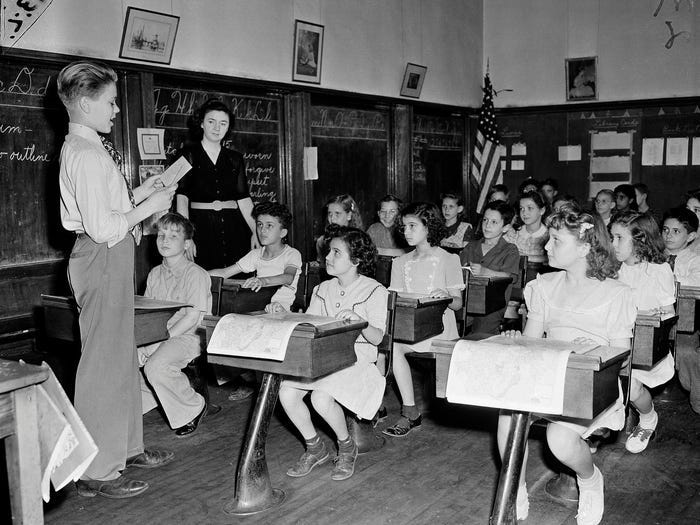
You have to live in your head.
The child in the forest learned through her senses, in the company of others, fully present to what was happening around her.
The child in the classroom learns through symbols, often alone with a text, mentally elsewhere—constructing abstract models of things she cannot see, touch, or directly experience.
Both are learning. But they require entirely different modes of cognition.
What We’re Training
Here’s what I’ve come to believe:
Modern education doesn’t just teach content. It trains a cognitive style.
Every hour in a classroom is an hour practicing abstract attention—holding focus on symbols, processing information about absent things, delaying application, living in your head.
By the time we’re adults, this feels normal. We don’t remember that there’s another way to learn, another way to know, another way to pay attention.
We’ve been trained out of embodied attention so thoroughly that we need special practices—meditation retreats, mindfulness apps, craft hobbies—to access what used to be the default mode of learning.
The Mbuti child didn’t need to practice presence. Presence was built into how she learned. Her education required her to be here, attentive to what was actually happening, engaged with the real texture of the world.
Our education requires the opposite. And then we wonder why we can’t stop living in our heads.
Windows Back to the Ground
This is why certain experiences feel like relief.
Working with your hands. Cooking a meal from scratch. Learning a craft from someone who already does it, watching their movements, trying to match them. Playing a sport where the feedback is immediate and physical.
These aren’t luxuries or hobbies. They’re windows back to the original way of knowing.
And this is why working with horses keeps appearing in this series. You cannot learn from a horse through abstraction. You cannot read a book about horsemanship and then apply the principles. The horse responds to what you’re actually doing—your body, your attention, your presence—right now.
Learning from a horse is observational, embodied, immediate. It requires exactly the kind of attention that the Mbuti child brought to learning in the forest. And it develops that attention, strengthens it, makes it available again.
What to Take From This
I’m not arguing we should abandon abstract learning. I couldn’t write this, and you couldn’t read it, without the cognitive capacities that abstract education develops.
But I think it is important to see the trade.
On the ground, learning and presence were inseparable. The way you came to know things kept you anchored in the sensory world, in the company of others, in direct contact with reality.
We traded that for something powerful—the ability to learn at scale, across time and space, about things we’ve never experienced.
But the trade had a cost we rarely name: we trained ourselves out of embodied attention. We made living in our heads the default. We created a world where presence has to be deliberately cultivated because nothing in our education teaches it anymore.
Understanding this doesn’t fix it. But it reframes the problem.
The difficulty you have staying present isn’t a personal failing. It’s the predictable result of spending your entire childhood learning to pay attention to things that weren’t there.
And every time you learn something through watching and doing—every time you return to embodied attention—you’re not just acquiring a skill.
You’re visiting the ground.
Next week: Natural Environments—why your nervous system is still looking for the forest, and what happens when it can’t find it.
—James
Note on AI collaboration: The Alive Letter explores how humans can stay fully human while learning to work with modern technology. In that same spirit, I collaborate with AI in the creation of these articles. As an industrial/organizational psychologist who studies human-AI collaboration, I carefully guide, refine, and evaluate AI outputs. At its best, this partnership helps me more clearly and authentically communicate my own thoughts and perspectives than I am able to alone.
Excellent analysis! I love how AI, despite abstraction, still teach you 'enskilment'. Like, who is the teacher now? Fun stuff!