

This is the second article in December’s series, “Life on the Ground.” In November, we climbed the Ladder of Abstraction—tracing how each technological revolution moved humans further from direct experience. We ended at the top: AI, models of models, maximum abstraction. This month, we’re exploring what’s still there at the bottom. What did abstraction cover up? What have we been standing on this whole time?
Last week, I introduced the distinction between immediate-return and delayed-return environments—the two worlds humans have inhabited across our history. This week, we examine the first of four factors that make immediate-return environments so conducive to presence and wellbeing: immediate feedback.

You plant a seed. You wait months to see if it grows. You submit a report. You wait weeks for a performance review. You start saving for retirement. You wait decades to learn if it was enough.
Modern life is built on delay. We act now; we learn later. Sometimes much later. Sometimes never.
This is so normal to us that we barely notice it. But step back and the strangeness becomes apparent. For over 95% of human history, we lived in environments where feedback was immediate. You threw a spear; you saw instantly if it hit. You gathered berries; you ate them that day. You said something unkind; you saw the reaction on someone’s face right now.
The gap between action and consequence was minimal. And this, it turns out, changes everything about how the mind works.
The Mind That Waits
When feedback is immediate, there’s no need to simulate the future. You don’t have to guess whether your effort is paying off—you can see it. You don’t have to construct mental models of possible outcomes—the outcome is right in front of you.
But when feedback is delayed, the mind must compensate. It has to infer progress. It has to estimate trajectories. It has to imagine scenarios that haven’t happened yet, run simulations, project forward, plan.
This is what psychologist Leonard Martin calls “I-D compensation theory.” The “I” stands for our innate, evolved predisposition toward immediate feedback. The “D” stands for the delayed-return environments most of us now inhabit. And “compensation” refers to the abstract cognitive strategies we’ve developed to bridge the gap.
We evolved to receive rapid, frequent feedback on our goal-directed efforts. When that feedback disappears—stretched out over weeks, months, years—we don’t simply accept the silence. We fill it. We fill it with planning, forecasting, rumination, worry. We fill it with what Martin calls “delayed-return skills”: the abstract thinking patterns that let us navigate a world of distant consequences.
These patterns are adaptive. They help us succeed in complex environments with long time horizons. But they come at a cost. The more we rely on mental simulation, the less we inhabit the present moment. The mind that’s busy forecasting the future has less capacity to attend to what’s actually here.
What Happens When Feedback Returns
The relationship between immediate feedback and presence isn’t just theoretical. Research with the Mbendjele BaYaka, an immediate-return foraging community in the Democratic Republic of the Congo, reveals something striking. When given a choice between receiving one unit of food today or five units tomorrow, those living in the traditional immediate-return environment chose the immediate option. A separate group of Mbendjele BaYaka who had moved to a nearby town—a more delayed-return context—chose to wait for the larger reward.
This isn’t about logical reasoning or self-control. It’s about cognitive calibration. In an immediate-return environment, prioritizing the present is adaptive. There’s no refrigerator. There’s no bank account. What matters is what’s here now.
More importantly, the study showed these cognitive styles are malleable. They adjust to environmental context. Change the feedback structure, and you change how the mind orients in time.
Even within modern delayed-return environments, the relationship holds. Research in organizational psychology consistently finds that delays between effort and feedback reduce the ability to sustain attention, decrease states like flow and work absorption, and increase mind-wandering. Timely feedback, on the other hand, is recognized as one of the most powerful factors in goal-setting theory. When people receive rapid information about their progress, they stay engaged. When they don’t, the mind drifts.
Embedded Points of Return
So what do we do? We can’t return to foraging. We have mortgages and deadlines and long-term projects that genuinely require planning.
But we can recognize what’s happening and design accordingly.
Martin suggests that people in delayed-return environments can satisfy their immediate-return needs by first breaking down long-term goals into smaller sub-tasks, and then giving full attention to the task at hand. Structure the work using abstract thinking. Then do the work using present-moment awareness. In his words: we can “live in the present without living for the present.”
This is why certain activities feel so different from the rest of modern life. Cooking. Woodworking. Playing music. Gardening—when you’re actually in the dirt, not planning the garden.
And working with horses.
A horse doesn’t wait until your quarterly review to tell you how you’re doing. The feedback is immediate and unambiguous. You shifted your weight; the horse responded. You held tension in your shoulders; the horse moved away. You exhaled and softened; the horse came closer. There’s no lag. No interpretation required. No wondering whether you’re on the right track.
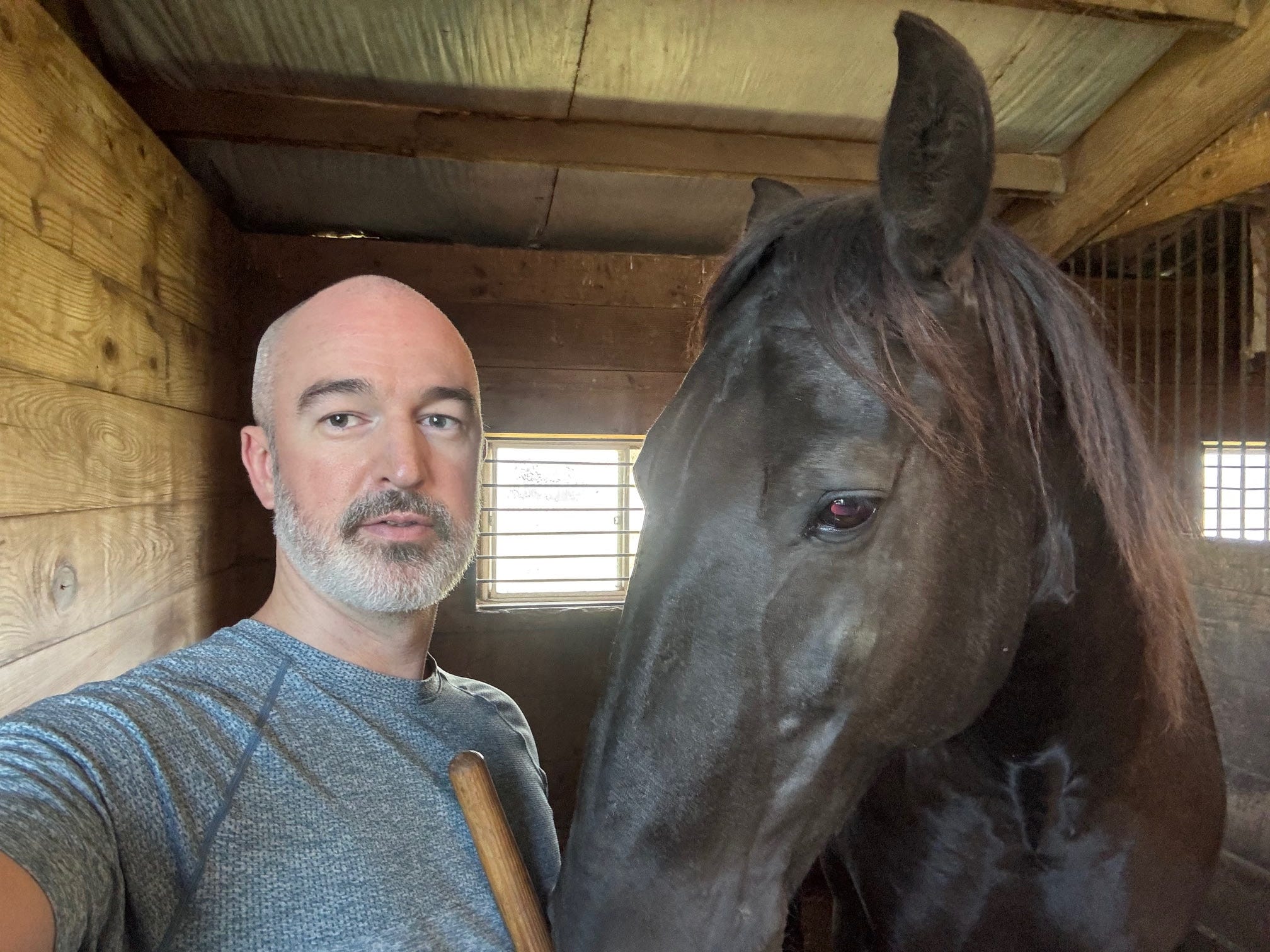
This is why equine-assisted learning is such a powerful setting for developing presence. Because horses restore the feedback structure our minds evolved to expect. They collapse the delay.
The Anxiety of the Gap
Here’s the deeper point: much of what we call anxiety may be the mind’s attempt to fill the space where feedback used to be.
When you don’t know how things are going, the mind generates possibilities. When you can’t see the consequences of your actions, the mind imagines them—often catastrophically.
Worry, in this view, isn’t a character flaw. It’s a coping mechanism for a delayed-return world.
The Pirahã of the Amazon have no word for “worry.” This isn’t because they’ve achieved some advanced spiritual state. It’s because their environment doesn’t require forecasting the future. When feedback is immediate, worry has no function. There’s nothing to fill.
This doesn’t mean we should stop planning. It means we should recognize that our constant mental churning isn’t inevitable. It’s contextual. It’s adaptive. It’s a response to an environment that withholds information.
And it means we can design pockets of our lives—activities, practices, environments—that restore the feedback our minds are looking for. Not to escape delayed-return reality, but to balance it. To give ourselves regular access to the cognitive relief that comes from knowing, right now, where we stand.
In future articles, we’ll get practical: how to design a life that lets us live in the moment without living for the moment. How to embed opportunities for feedback. How to give the mind what it needs so it can actually rest—not through force of will, but through the structure of how we live.
Next week: “Learning by Watching and Doing”—observational learning and what happens when we replace direct experience with more abstract forms of learning.
—James
Note on AI collaboration: The ALIVE Letter explores how humans can stay fully human while learning to work with modern technology. In that same spirit, I collaborate with AI in the creation of these articles. As an industrial/organizational psychologist who studies human-AI collaboration, I carefully guide, refine, and evaluate AI outputs. At its best, this partnership helps me more clearly and authentically communicate my own thoughts and perspectives than I am able to alone.