

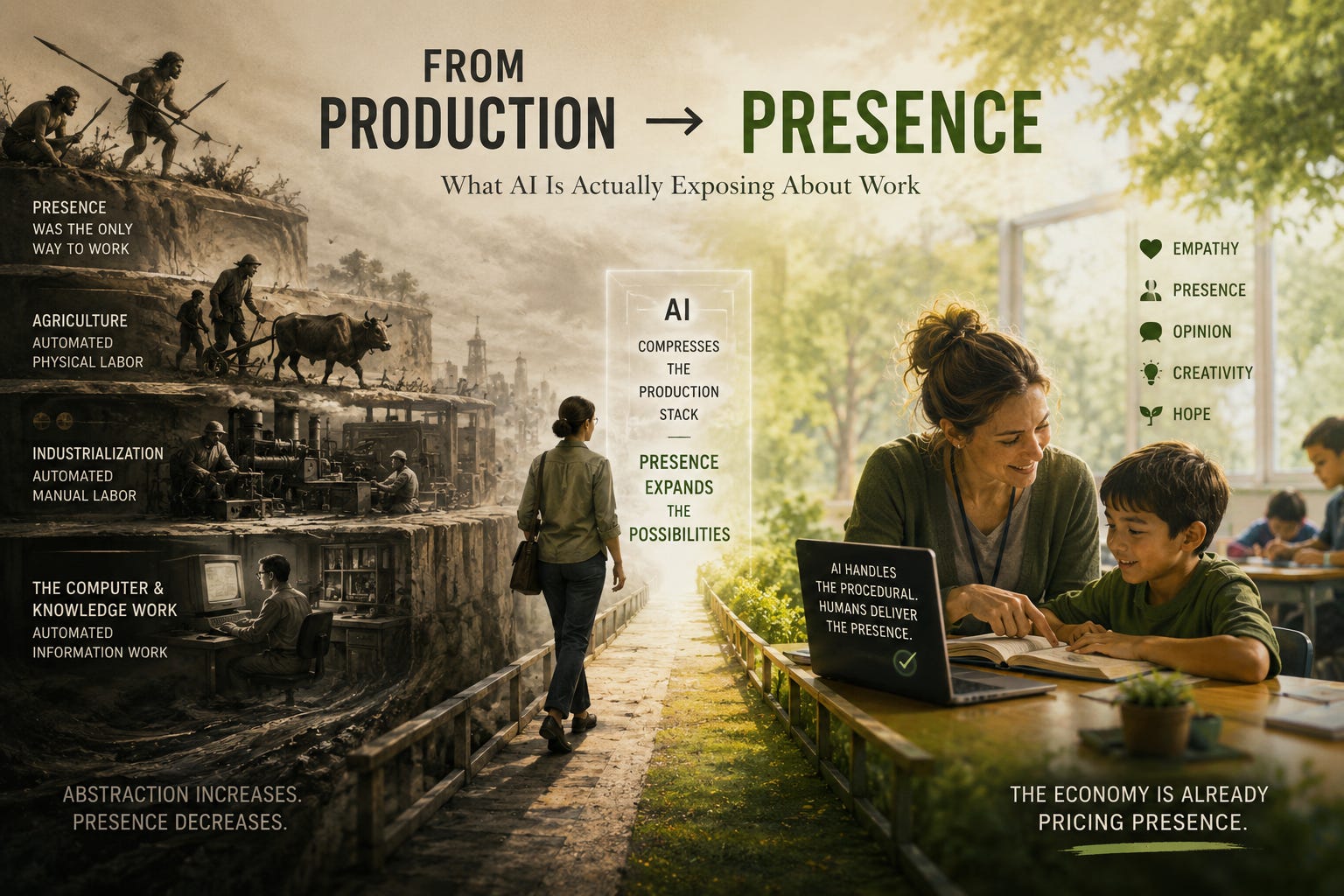
For most of human history, presence was not a skill. It was the only way to work.
Immediate feedback. Physical consequence. Learning by watching and doing. The environments humans occupied for nearly all of our existence were ones that demanded your full attention, right now. You could not abstract your way through reading a river or tracking an animal. Presence did not need to be practiced, it was the natural cognitive state.
Then came what I’ll call the “production revolutions.”
Agriculture, industrialization, the computer, knowledge work. Each automated the most repeatable layer of the previous era and pushed human labor, from physical to cognitive, into something more complex. More abstract. Further from the physical, deeper into the conceptual. The feedback loops stretched. The sensory anchors dissolved. Each revolution asked more of the mind and less of the body, less of the immediate moment.
We have been moving in that direction for ten thousand years. And now, for the first time, the direction might be changing.
AI does not push human workers into a new production layer. It compresses the entire production stack. The procedural — the codified, the documentable, the analytically correct — arrives faster and cheaper than any specialist could deliver it. What remains, after that compression, is the thing every revolution has been moving us away from.
Presence. Judgment. Genuine human relationship.
MIT Sloan researchers Isabella Loaiza and Roberto Rigobon recently tried to measure this shift at scale. Their EPOCH framework — Empathy, Presence, Opinion, Creativity, Hope — identifies the human capabilities that complement rather than compete with AI. Using network-based methods to map task interdependencies across all U.S. occupations, they found that new tasks emerging in 2024 carry significantly higher EPOCH scores than pre-existing tasks. Jobs with high EPOCH scores showed stronger employment growth from 2015 to 2023, higher hiring rates in 2024, and more favorable projections through 2034.
The P in EPOCH is Presence. The economy is already pricing it.
Last week, NPR ran a story about special education teachers using AI, and it is the clearest illustration of this I have seen in the news.
Special educators in the U.S. are overwhelmed. Forty-five states reported teacher shortages in the 2024-25 school year, and the paperwork burden is a major reason people leave. For each student with a disability, teachers must develop an Individualized Education Program — a detailed, legally required document tailored to that child’s specific needs. A teacher named Mary Acebu described spending 45 minutes developing just three or four IEP goals per student, cross-referencing a five-inch-thick binder of state standards.
She now uses AI for that. The time savings are real. But the reason the story matters is what she does with that time: she is with her students.
A researcher at the University of Central Florida who has been studying AI in special education put it plainly: the more face time a student with a disability has with a teacher, the better the outcomes, across every dimension. In Acebu’s class, a student who couldn’t read last year is now reading.
AI compressed the production layer. The presence layer expanded. Outcomes improved.
This is not a soft story about technology being helpful. It is a preview of what the economy is beginning to require. Presence as a hard skill.
Because using AI well — actually well, not just efficiently — also requires presence, the very capacity we have spent decades training away. You have to read AI output with genuine judgment. Know what good looks like before the analysis confirms it. Sense when the problem itself needs to be reframed, not just answered. A tool built on pattern recognition is structurally limited when the task legally requires individualization. You cannot catch that limitation without genuine discernment — and discernment is precisely what years of abstraction-heavy knowledge work quietly erodes. Concerningly, CDT’s research found that 15% of special education teachers are already relying on AI to develop IEPs entirely on their own.
My research on how environments shape cognition suggests that the presence underlying human judgment and relationship is not simply a matter of effort or intention. Sustained knowledge work trains abstraction as the default cognitive mode, progressively eroding the capacity for the concrete, present-moment processing that presence actually depends on. That erosion happens slowly, over years, and rest alone does not reverse it. The environment has to change.
We evolved for presence. The production era, for a relatively short moment in human history, moved us away from it. The AI era might make it economically indispensable again.
- James